Submit a written complaint
If you’re not satisfied with the retirement home’s response, you may submit a formal written complaint to the RHRA.
A written complaint is typically used when:
- concerns remain unresolved
- you would like the RHRA to formally review your concern
- you would like a written decision explaining the outcome of the process
Before you submit a written complaint
If you’re considering submitting a written complaint, it may help to understand your options first.
Many concerns can be resolved through guidance, early intervention or other informal approaches without requiring a lengthy complaint process. However, where a formal review is needed, a written complaint may be the most appropriate option.
Contacting us can help you determine the most appropriate next step for your situation.
Unlike reports of harm or risk of harm, written complaints cannot be anonymous because we may need to contact you during the complaints process. The retirement home has a right to respond to your written complaint. We will provide you with a decision letter at the conclusion of the process.
What to expect
A written complaint involves a formal process.
Depending on the concerns raised, we may need to:
- gather and assess information from multiple sources
- request information from the retirement home
- review records and documents
- conduct inquiries or inspections, where necessary
- carefully consider all information before reaching a decision
At the end of the process, we provide a written decision explaining the outcome of the review and any resulting actions.
Because each complaint is different, processing times can vary depending on the nature and complexity of the concerns raised.
How to submit a written complaint
You can submit a written complaint through:
Self‑Service Portal (recommended)
Fastest and most secure option with immediate confirmation and a case number.
Complaint Form
A fillable PDF form with all required fields; you can submit to us by email, mail or fax (this information can be found on the contact us page).
Include the home’s name and location and as much detail as possible (what happened, when and who was involved, and any steps already taken to address the concern).
Letter
Submit your written complaint to the RHRA via mail or fax. You can find this information on the Contact Us page.
If you’re unsure how to describe your concern, share what you can and we’ll help you fill in the gaps.
You can also refer to our video guide on the process.
If you are submitting a complaint for a resident
To protect privacy, we may require consent forms or legal documentation before sharing personal information.
Depending on the situation, this may include:
Resident is legally able to make their own decisions
Resident is not legally able to make their own decisions
- Substitute Decision-Maker Consent Form
- Power of Attorney or guardianship documents, depending on the type of information involved
- Authorization Form signed by the resident’s Attorney or Guardian (if you are not the resident’s Attorney or Guardian)
Resident is deceased
- Estate Trustee documentation (either the resident’s Will or the Certificate of Appointment of Estate Trustee)
- Authorization Form signed by the Estate Trustee (if you are not the resident’s Estate Trustee)
After you submit a written complaint
Every complaint is reviewed to determine the most appropriate way to address the concern while protecting resident safety and well-being.
The diagram below shows how a written complaint is processed by the RHRA.
The process begins with a review and risk assessment. Based on the information available, the complaint may proceed through early complaint resolution, an inquiry or an inspection.
Each pathway has different timelines and service standards.
For more information, see Timelines and Service Standards.
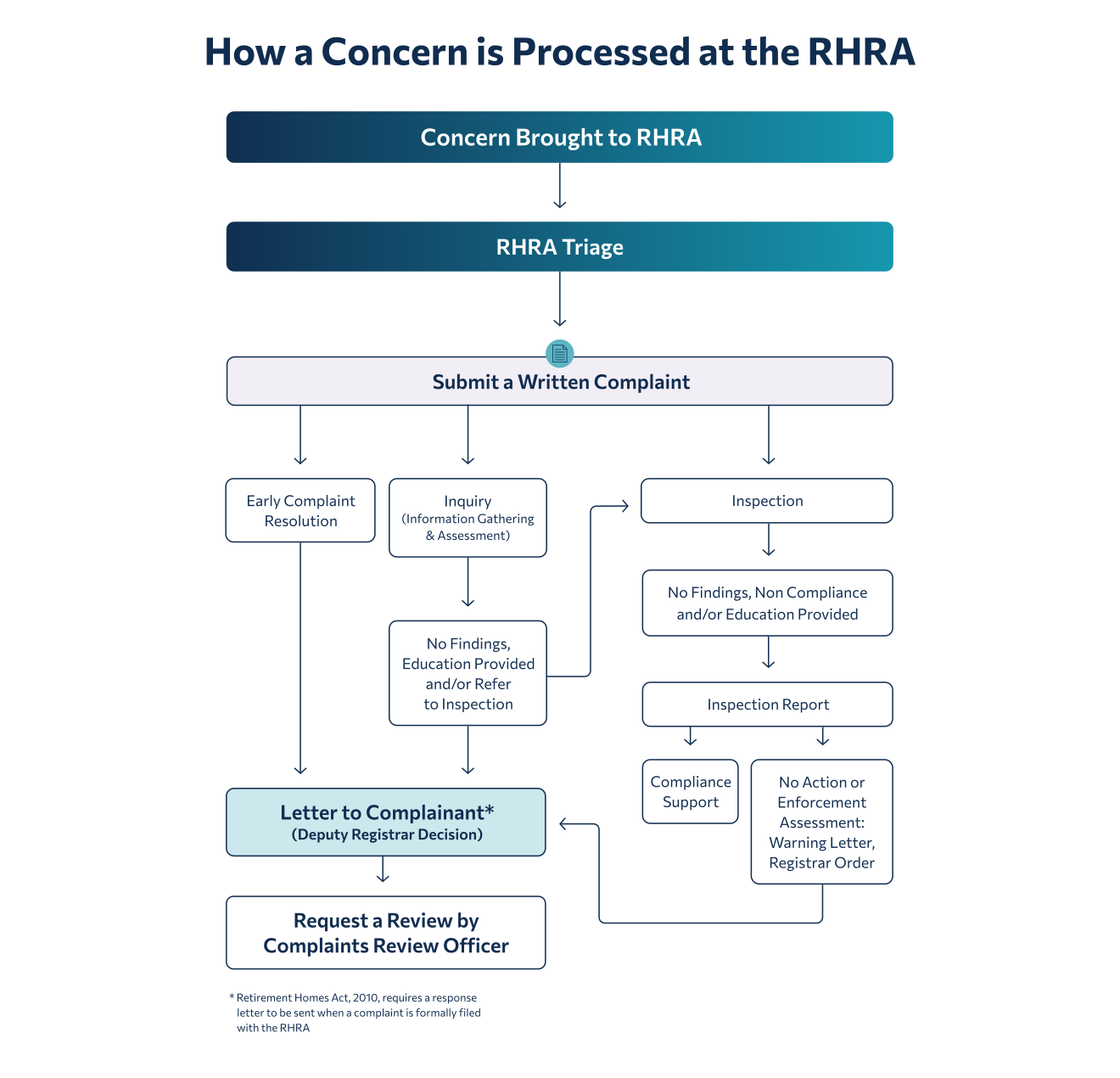
When a written complaint is received, we review and assess it to understand:
- the nature and complexity of the concern
- the level of risk
- the information provided
- whether additional information is needed
Once the review is complete, we address the complaint through the most appropriate way to review the complaint:
- Early complaint resolution for concerns that may be resolved more quickly
- Inquiry where additional information gathering and review are required
- Inspection where concerns are more complex, higher risk or require further investigation
For lower-risk concerns where there is no serious harm or immediate risk of harm, we may work with you and the retirement home to address issues and find solutions, where possible.
This approach can often lead to faster outcomes while still ensuring the concerns raised in the complaint are reviewed and addressed.
If the complaint is resolved through early complaint resolution, we will provide the complainant with a letter outlining the outcome and the matter will be closed.
If the complaint cannot be resolved through early complaint resolution, it may proceed to an inquiry or inspection.
An inquiry helps us better understand the concern.
This may include reviewing records and documents, requesting additional information and speaking with those involved.
Following an inquiry, we may:
- determine there are no findings and close the matter
- provide education to support the home’s compliance
- determine that further review is required
If further review is required, we may conduct an inspection.
If a concern is serious involving an immediate risk to residents or requires further review after an inquiry, we may conduct an inspection.
Following an inspection, we may:
- determine there are no findings and close the matter
- identify non-compliance with legislative requirements
- provide education to support the home’s compliance
At the end of the complaint process, you will receive a letter explaining the outcome of our review.
The letter will summarize the concerns raised, the steps taken to review the complaint and any findings or actions resulting from the review.
Depending on the circumstances, the outcome may include:
- no findings
- education or guidance provided to the retirement home
- compliance requirements
- warning letters
- Registrar’s Orders
If you are not satisfied with the decision, you may ask the Complaints Review Officer (CRO) to review it.
Your request must be made in writing within 60 days of receiving the decision letter.
The CRO is independent of the RHRA and reviews the decision and the information considered during the complaint process.
To explain your concerns, you may choose to complete a Confirmation of Concerns Form, although it is not required.
After completing the review, the CRO may:
- uphold the decision
- or refer it back to the Registrar or Deputy Registrar for further review
You will receive a written letter explaining the outcome. Decisions made by the CRO are final and cannot be appealed at the RHRA.