Know what must be reported, how to report it and what happens next
Under the Retirement Homes Act, 2010, individuals who witness, become aware of, or have reasonable grounds to suspect that a resident has experienced harm or is at risk of harm are obligated to immediately report it to the RHRA.
This includes retirement home licensees, operators, staff, family members, substitute decision-makers (SDMs), external care providers and regulated health professionals such as doctors, nurses, therapists, naturopaths and social workers. Residents may also make a report, but they are not legally required to do so.
What must be reported to the RHRA
You must immediately report harm or risk of harm to a resident involving:
- abuse by anyone
- neglect by the licensee or staff of the retirement home
- improper or incompetent treatment or care
- unlawful conduct
- misuse or misappropriation of a resident’s money or property
Examples of reportable harm include:
- Physical harm: A resident is roughly handled during care, resulting in pain, bruising or injury.
- Verbal or emotional harm: A resident is yelled at, threatened, humiliated or intimidated, causing fear, distress or anxiety.
- Financial harm: A resident’s money or property is stolen or a resident is coerced, intimidated or manipulated into giving money, gifts or belongings to another person.
Financial harm may not involve immediate physical injury, but it is a serious violation of a resident’s rights and protections under the law and must be reported.
Examples of reportable risk of harm include:
- Fall risk: A resident’s plan of care requires two staff members to assist with transfers due to a fall risk. If only one staff member assists and the resident slips—even if no injury occurs—this is a risk of harm and must be reported.
- Safety risk: A door alarm or locking system does not function properly, and a resident is unable to re-enter the building after going outside (for example, after regular hours). Even if no one is harmed, exposing a resident to extreme weather or preventing access to help is a risk of harm and must be reported.
For detailed definitions and examples of abuse and neglect, see the Guidance Document for Abuse and Neglect.
When in doubt, report.
If you are unsure whether an incident should be reported, contact us for guidance. A concern does not need to result in actual harm to be reportable if there was a risk that harm could occur.
How to report to the RHRA
Reports should be submitted through the Self-Service Portal.
The portal is the fastest way to submit a report of harm or risk of harm. It captures all required information and provides immediate confirmation and a case number, allowing you to track your submission and supporting faster processing of urgent situations.
For external care providers: You may report concerns directly to the RHRA. If you are comfortable doing so, you may also notify the retirement home. Once the home becomes aware of a reportable incident, it is required to report it to the RHRA immediately.
For step-by-step guidance and more information, see:
If you need help using the portal, contact our team.
What happens after a report is submitted
The diagram shows how a report of harm or risk of harm is processed by the RHRA.
Every report received by the RHRA is reviewed and assessed as soon as it is received.
Retirement homes can expect to be contacted by the RHRA promptly following our receipt of a report, typically within days or immediately in urgent situations.
Based on the level of risk and the circumstances of the report, we determine the most appropriate next step: an inquiry or an inspection.
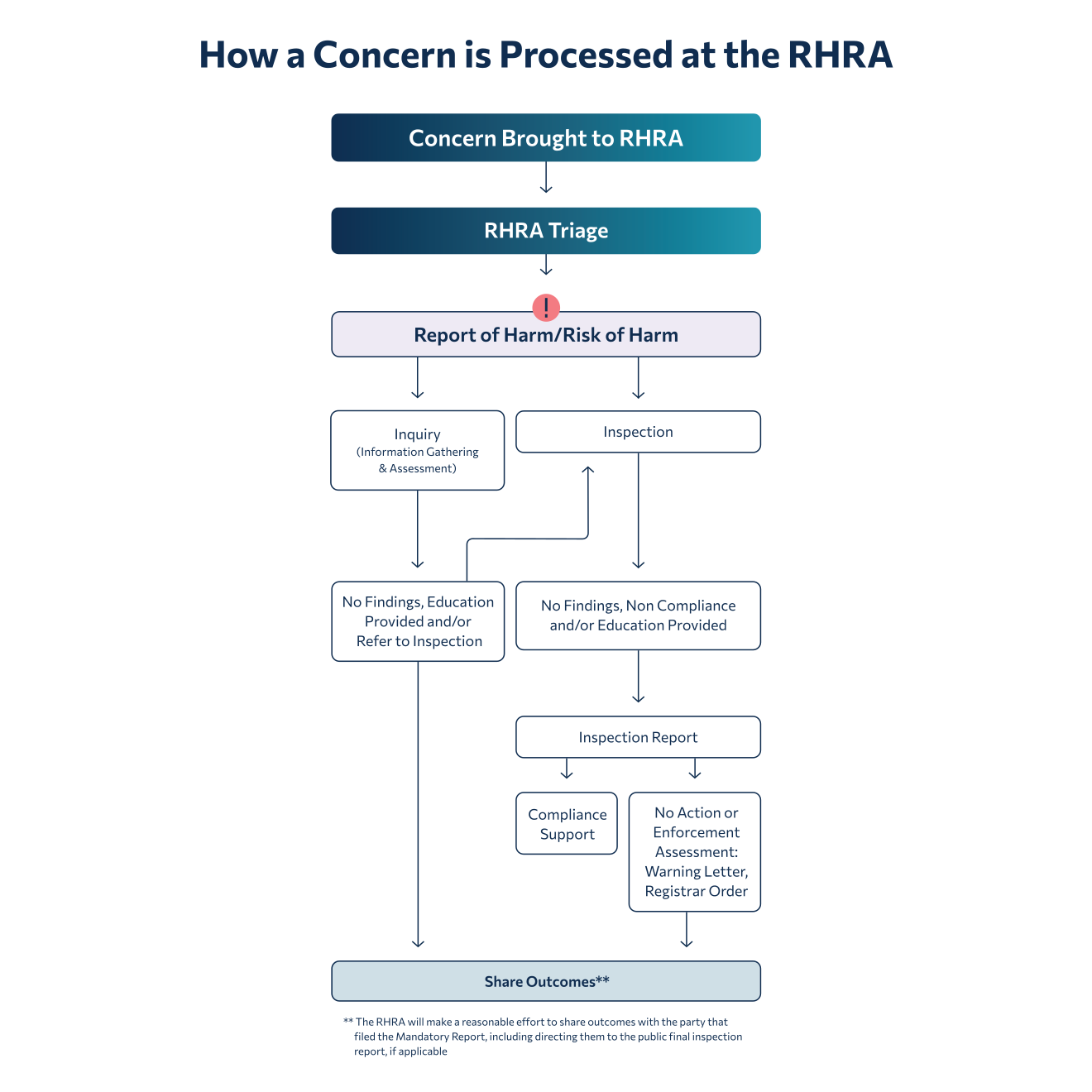
The sections below explain each step of the reporting process in more detail. For information about response times and service standards, see Timelines and Service Standards.
An inquiry involves gathering and reviewing information to help us better understand the concern.
This may include reviewing the home’s compliance history, requesting records or additional details, and determining whether the issue is isolated or recurring and whether appropriate steps have been taken to address it and reduce future risk to residents.
Findings and next steps
Following an inquiry, we may:
- determine that the home met legislative requirements and close the matter
- provide education to support the home’s compliance and protect resident safety
- determine that further review is required
If further review is required, we may refer the matter for an inspection.
An inspection may be conducted when there are concerns about safety, potential non-compliance with legislative requirements, or where further review is required after an inquiry.
We typically initiate inspections within five (5) business days, or as early as the next business day for urgent situations where there is a significant risk to resident safety and well-being.
In some cases, other authorities (such as police or fire services) may also be involved. We may need to adjust our response to coordinate with these investigations.
Findings and next steps
Following an inspection, we may:
- determine that the home met legislative requirements and close the matter
- identify non-compliance with legislative requirements
- provide education to support compliance
Inspection report
The inspection report summarizes the findings of the inspection and any required follow-up actions.
Once the inspection process is complete, the final inspection report is published on the Retirement Home Database, with confidential information removed.
Compliance support and enforcement
Where non-compliance is identified, we may:
- provide compliance support
- determine that no enforcement action is required
- assess whether enforcement action is appropriate under the Retirement Homes Act, 2010, such as issuing a warning letter or a Registrar’s Order
The retirement home receives information about the findings, any required next steps and any compliance support or enforcement measures that may apply.
We make reasonable efforts to keep the person who submitted the report informed about the status and outcome of the matter. This may include providing information about actions taken or directing the individual to a public inspection report on the Retirement Home Database.
If a report is submitted anonymously, the RHRA may not be able to provide updates or share outcomes.

Privacy and protections
Information is collected only for regulatory purposes and is shared only with consent or where permitted by law.
Guidance and resources
Tools and guidance are available to support reporting and clarify what must be reported:

Mandatory Reporting Fact Sheet

Mandatory Reporting Poster

Guidance Document for Abuse and Neglect

Insight Series — Issue 1: Compliance Trends in Protection from Abuse and Prevention of Neglect

Compliance Assistance Module: Protection from Financial Abuse